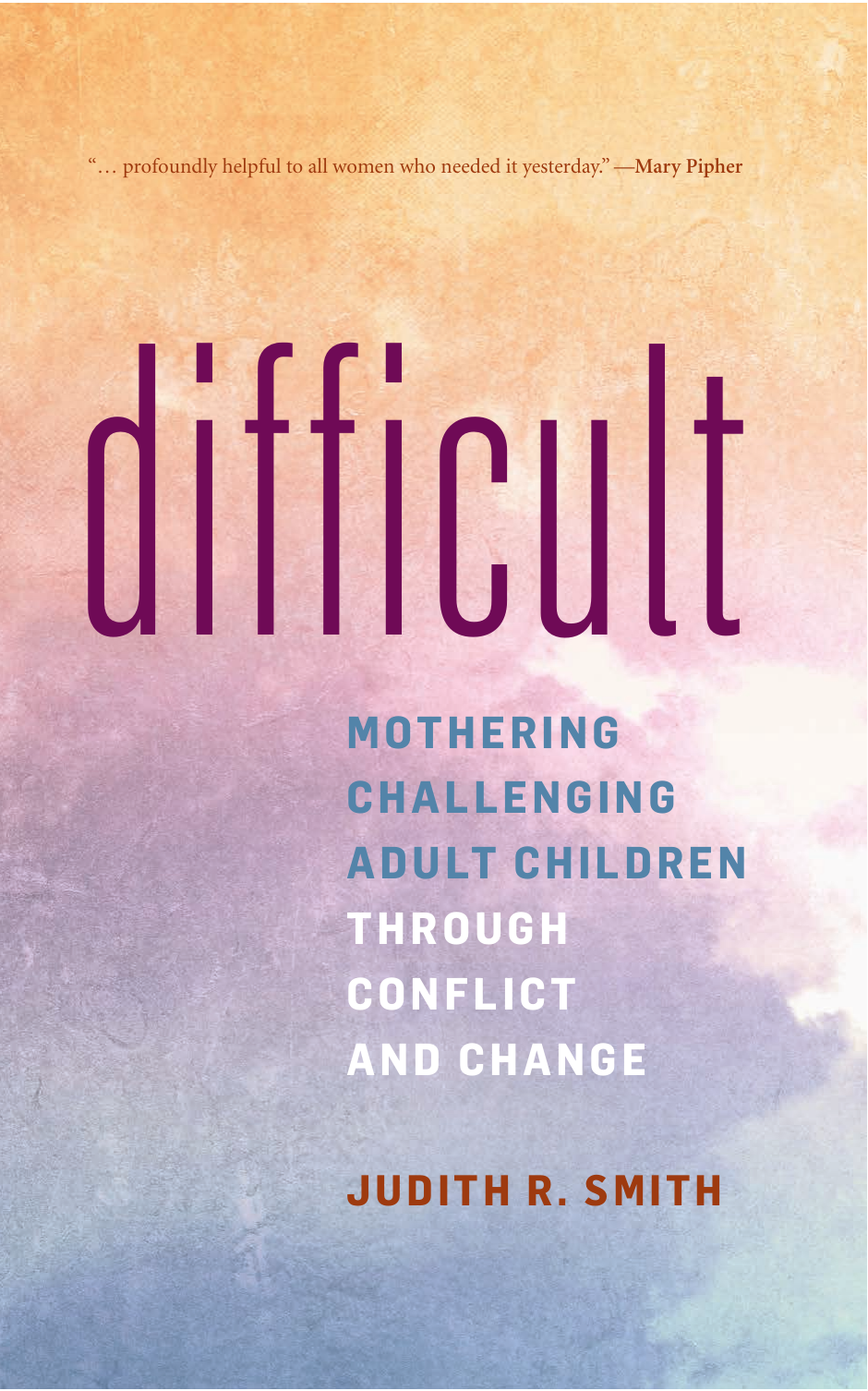
THE BOOK
You Didn't Expect to Be "Mom" Again — Not Like This.
If your adult child has come back home, or never really left — if mental illness, substance use, or chronic instability has quietly taken over a decade you thought would be yours — you are living something most people don't talk about. Difficult is the book for the mothers who are.
How This Book Came to Be
Difficult is based on a series of in-depth interviews Judith Smith conducted with women, all over 60, from a wide range of socio-economic and geographic backgrounds. Despite how different their circumstances were, the same patterns kept surfacing: nearly all had reopened their homes to adult children who had nowhere else to go.
Most of those adult children were living with mental illness, substance use disorder, or both. None of these women had expected their later years to be framed, once again, by the word parent.
It was searching for a name for what she was seeing — and for what it cost these women — that led Smith to the term Difficult Adult Child: a name chosen to acknowledge both the child's struggle and the hardship it hands to the mother who carries it alongside them.
“If not me, when who?”
In the absence of adequate mental health support and affordable housing, this is the question mothers are left holding — often alone.
What You'll Find Inside
Difficult speaks directly to the embarrassment, shame, and helplessness so many women feel when a child's struggles start to feel like a referendum on their own worth as a mother. It names something rarely said out loud: that unpaid, unrecognized maternal caregiving doesn't end when a child turns 18 — for many women, it starts over.
The book also offers something practical. Difficult draws on the hard-won wisdom of leading practitioners in mental health and elder abuse, and it situates every mother's story inside the larger forces shaping it — an underfunded mental health system, the quiet cultural mandate to be a "good mother" at any cost, and a social safety net that was never built to catch families like these.
Inside you’re find:
Real stories from women living this, in their own words
Practical strategies drawn from mental health and elder-care professionals
A way to see your own situation as part of something larger — not a personal failure
Not sure yet?
Read the first 3 chapters, free — no strings attached.
Order Your Copy Today
Available in hardcover, paperback, ebook, and audiobook — wherever you like to read.